Executive Summary
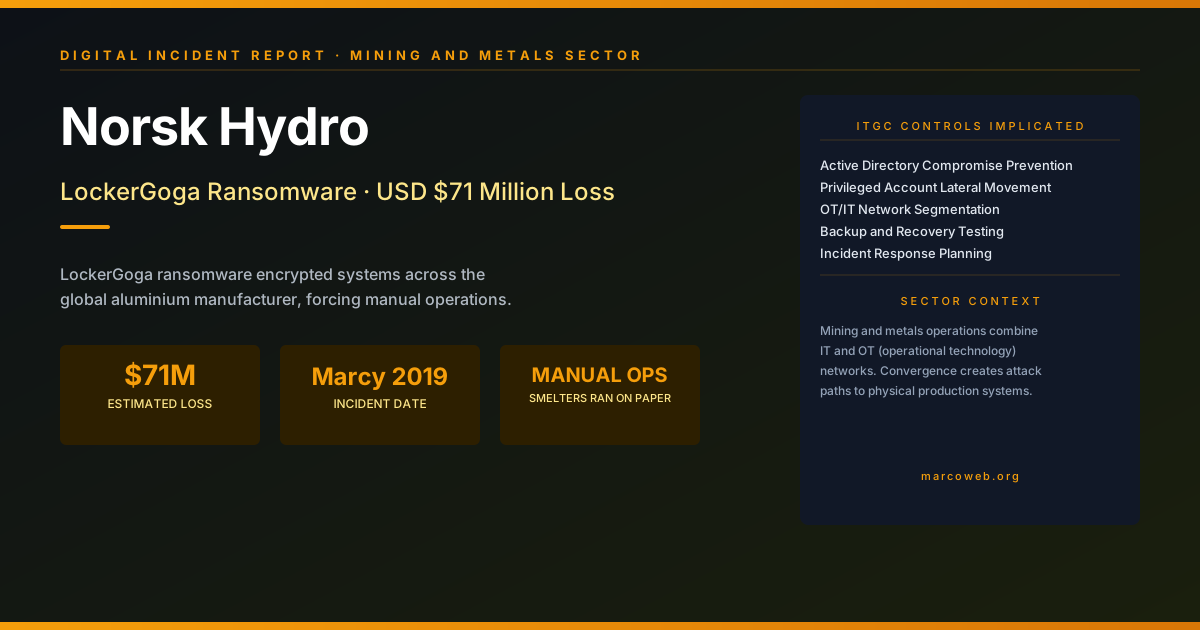
On 19 March 2019, Norsk Hydro ASA, one of the world’s largest aluminium producers, detected unusual activity in its IT environment that quickly escalated into a full ransomware incident. LockerGoga ransomware had been deployed across Hydro’s global network, encrypting Windows systems at facilities in Europe, North America, and Brazil.
Hydro’s initial response was notable for its transparency: the company held press briefings within hours of detecting the attack, provided daily updates, and published detailed financial estimates of the incident’s cost as it progressed. The company explicitly declined to pay the ransom.
The physical operational impact was significant. Norsk Hydro’s Alunorte alumina refinery in Brazil and its primary metal plants in Norway were forced to switch from automated to manual operations. Hydro’s Extruded Solutions business, which provides aluminium profiles to the automotive and construction industries, shifted to manual processing across its 35,000 person workforce.
The estimated total cost of the incident was approximately NOK 650 million (approximately USD $71 million), comprising lost production, response costs, and system rebuilding.
Incident Overview
Date: 19 March 2019
Organisation: Norsk Hydro ASA (global aluminium producer, listed on Oslo Stock Exchange)
Systems affected: IT systems across global operations; approximately 22,000 computers
Operational impact: Smelters switched to manual operations; Extruded Solutions business severely affected; Alunorte refinery ran at reduced capacity
Estimated loss: Approximately USD $71 million
Attack vector: Active Directory compromise using stolen credentials, followed by LockerGoga deployment
Attribution: The FBI, Europol, and Norwegian police have investigated; no public government-level attribution as of this report date
Technical Analysis: What Happened
The Norsk Hydro attack followed a pattern that has become characteristic of sophisticated ransomware operations: initial access through credential compromise, followed by privileged lateral movement, Active Directory compromise, and finally ransomware deployment from a position of domain-wide control.
Phase 1: Initial access. The entry vector for the Norsk Hydro attack has been attributed to a phishing email received several months before the ransomware deployment. The phishing email delivered a credential-harvesting payload that provided the attacker with initial access to a user account within Hydro’s network.
Phase 2: Lateral movement and privilege escalation. Over the weeks and months following initial access, the attacker moved laterally through Hydro’s network, escalating privileges and ultimately obtaining domain administrator credentials. This dwell time, between initial access and ransomware deployment, is characteristic of sophisticated operators who invest in establishing a position of maximum impact before activating the destructive payload.
Phase 3: LockerGoga deployment. LockerGoga was deployed as a Group Policy Object, distributed to Windows systems across the domain through the compromised Active Directory infrastructure. This deployment method is highly effective: it uses the legitimate domain management infrastructure to distribute the ransomware, bypassing controls that might detect external network-based distribution.
Phase 4: Encryption. LockerGoga encrypted files on affected systems. Unlike many ransomware variants, LockerGoga also changed user account passwords and logged users out of their systems, preventing recovery attempts. The malware was not designed for rapid worm-style propagation; its effectiveness depended on the attacker’s pre-positioning at the domain level.
OT/IT Convergence: The Mining-Specific Risk
The physical operational impact of the Norsk Hydro attack illustrates a risk that is specific to process industries: the convergence of IT and operational technology (OT) systems.
Modern aluminium smelters, refineries, and extruded products facilities rely on a combination of:
- SCADA and DCS systems that control physical production processes
- Manufacturing execution systems (MES) that manage production scheduling, quality data, and batch records
- Enterprise systems (ERP) that manage orders, inventory, and financial data
These systems are increasingly networked together to enable operational efficiency. The connection between enterprise IT and operational systems creates a pathway: a compromise that begins in the enterprise network can reach, or at minimum disrupt, the manufacturing environment.
At Norsk Hydro, the IT system encryption did not directly compromise the physical SCADA systems controlling smelter operations. However, the loss of manufacturing execution systems and enterprise connectivity forced smelters to operate manually: process engineers worked from paper records, phone communication replaced automated data systems, and production scheduling was performed by hand.
This is the IT/OT convergence risk in practice: even without directly attacking OT systems, an IT disruption can make automated production operations unmanageable, forcing a shift to manual processes that cannot sustain the same throughput or quality consistency.
ITGC Control Failures
Privileged Account Security and Lateral Movement Prevention: The Active Directory compromise that enabled domain-wide LockerGoga deployment required the attacker to obtain domain administrator credentials. Controls that would have detected and blocked lateral movement (privileged access workstations, privileged identity management, network segmentation between workstations) would have constrained the attacker’s ability to reach domain controller level.
Detection of Long Dwell Time Intrusions: The attacker maintained access to Hydro’s network for an extended period before deploying the ransomware. SIEM and user behaviour analytics controls that establish baseline patterns for privileged account activity would have detected the anomalous reconnaissance and lateral movement activity during this dwell period.
Group Policy Change Monitoring: The deployment of LockerGoga via Group Policy Object represents a misuse of legitimate domain management infrastructure. Controls that monitor Group Policy changes and alert on unexpected policy creation or modification in the production domain would have detected the ransomware distribution mechanism before execution.
Network Segmentation Between IT and OT: The inability to sustain automated operations following an IT compromise indicates that the manufacturing systems were sufficiently dependent on IT network connectivity that IT failure had direct operational consequences. Network segmentation and operational independence of production OT systems from enterprise IT reduces this dependence.
Offline Backup and Active Directory Recovery: The recovery timeline suggests that rebuilding from backup and restoring Active Directory required significant time. Tested offline backups of domain controller state and defined procedures for Active Directory forest recovery would have reduced the recovery timeline.
Hydro’s Response: A Model for Transparency
Norsk Hydro’s response to the attack is worth examining independently of the ITGC failures, because it demonstrated an approach that regulators and the security community have held up as a model:
Immediate public disclosure: Hydro informed the Oslo Stock Exchange within hours of detecting the attack and held a public press briefing on the first day. The CEO and CFO were present and took questions.
No ransom payment: Hydro explicitly declined to pay the ransom, consistent with law enforcement guidance and the position that ransom payment funds further attacks.
Daily financial updates: Hydro published regular estimates of the financial impact of the incident as it progressed, providing shareholders and the market with transparent information.
Cooperation with authorities: Hydro cooperated fully with Norwegian police and Europol investigations.
The transparency of Hydro’s response did not prevent the financial loss, but it preserved stakeholder trust and provided the broader security community with a realistic and detailed account of a large-scale ransomware recovery.
Lessons and Recommendations
Treat Active Directory as the crown jewel it is. Domain controller compromise enables everything that followed at Norsk Hydro. Privileged access workstations for all domain administration tasks, just-in-time privileged access, and monitoring of all domain controller authentication and policy changes are the controls that reduce this risk.
Hunt for dwell time intrusions, not just alerts. A detection program that only responds to real-time alerts will not detect an attacker who has been present in the environment for weeks. Threat hunting activities that look for anomalous historical patterns in privileged account activity can surface long-running intrusions before they escalate.
Plan for IT-dependent OT operations to run without IT. If your production operations cannot continue when enterprise IT is unavailable, that dependence is an operational risk. Maintaining the ability to operate critical production processes in a manual or isolated mode, with documented procedures and trained staff, limits the physical production impact of IT incidents.
Invest in offline Active Directory recovery capability. The domain is the dependency that amplifies ransomware damage from “encrypted PCs” to “unable to restore any system.” A tested offline recovery procedure for Active Directory, with a known recovery time, is the single control that most reduces the recovery timeline for a domain-wide ransomware event.
The ITGC controls most directly implicated in this incident map to the following audit testing areas:
- Privileged access management and domain controller protection
- Detection controls for lateral movement and dwell time
- Group Policy change monitoring and alerting
- OT/IT network segmentation adequacy
- Active Directory offline recovery capability and testing
Open the ITGC Audit Tool