Executive Summary
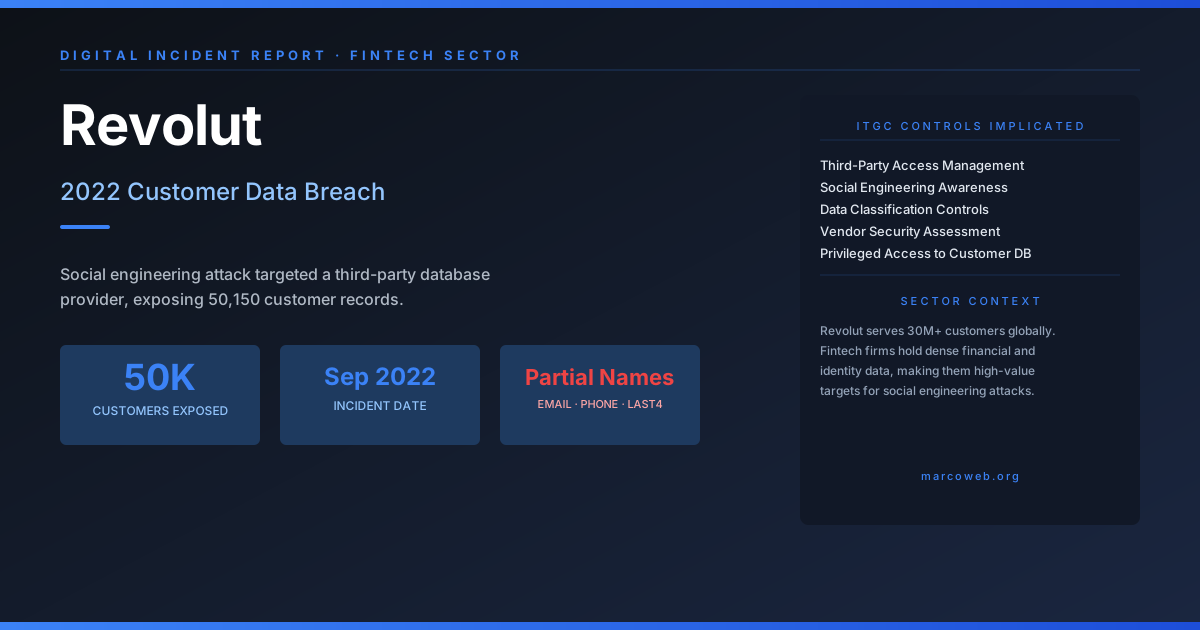
In September 2022, Revolut, the UK-registered fintech with over 30 million global customers, disclosed a data breach affecting 50,150 customers. The attack vector was social engineering: an attacker convinced an employee at a third-party data management provider to provide access to a customer database. The exposed data included partial card payment information, names, email addresses, phone numbers, and physical addresses.
No payment card numbers or PINs were accessed. No funds were stolen. The breach was, by the standards of the fintech industry, limited in scope.
The incident is significant not for its immediate impact but for what it reveals about the systemic risk in fintech firms: the concentration of rich, multi-attribute customer data in systems accessible to third parties, and the inadequacy of access controls and social engineering defences across the partner ecosystem.
Incident Overview
Date: September 2022
Organisation: Revolut Ltd (UK entity)
Customers affected: 50,150 (approximately 0.16 percent of Revolut’s global customer base at the time)
Data exposed: Partial payment card data, names, email addresses, phone numbers, and physical addresses
Attack method: Social engineering of a third-party data provider employee
Financial impact: Not publicly quantified; no direct fund theft confirmed
Regulatory action: The Lithuanian data protection authority (Revolut’s EU banking licence regulator) opened an investigation. The UK ICO was notified.
Technical Analysis: What Happened
Revolut uses a third-party service provider for certain customer data management functions. An attacker, using social engineering techniques, convinced an employee at this provider to grant access to Revolut’s customer data. The specific technique used has not been publicly disclosed but is consistent with pretext calling or phishing targeting the third-party employee.
The access was used to query the database and extract records for approximately 50,150 customers. A subset of the affected customers subsequently received phishing messages referencing their Revolut account, suggesting that the attacker used the extracted data as a basis for further social engineering attempts against customers.
Revolut identified the breach through internal monitoring, isolated the access, and notified the Lithuanian State Data Protection Inspectorate (where Revolut holds its EU banking licence) within the GDPR-required 72-hour window.
The key technical characteristics of this incident were:
Third-party access without granular restriction: The third-party employee’s access to the customer database was not restricted to the specific subset of records they legitimately needed to access. The attack succeeded because the access they could grant, once social engineering was successful, was broader than operational necessity required.
Social engineering of the human control layer: The access controls protecting the database were technically functional; the breach occurred by manipulating a human who held legitimate access. This is the defining characteristic of social engineering attacks: they bypass technical controls by targeting the people who hold authorised access.
Data aggregation enabling follow-on attacks: The combination of name, email, phone, and address data, while not sufficient to directly steal funds, provided the attacker with a profile rich enough to launch targeted phishing against Revolut customers who would not expect contact referencing their account details.
ITGC Control Failures
Third-Party Access Management: Revolut’s relationship with a third-party data management provider was governed by a contract and presumably by vendor security assessments. However, the incident indicates that the access the third-party employee held to Revolut’s customer data was broader than minimum necessary, and that the third-party’s own social engineering controls did not prevent credential sharing under pressure. Vendor security assessments that do not assess the social engineering resilience of provider staff are incomplete.
Principle of Least Privilege in Third-Party Data Access: A third-party provider whose employees require access to customer data should hold that access on a per-request, role-restricted basis. If the provider employee who was social-engineered held standing access to the full customer table rather than access scoped to specific operational functions, the access model was over-provisioned.
Social Engineering Awareness and Response Training: The failure point in this incident was a human decision made under social pressure. Training that specifically covers the social engineering scenarios used to target data custodians (pretext calls claiming to be internal IT, urgent access requests from apparent executives) is the control that reduces this risk.
Data Minimisation: The dataset extracted included physical addresses for a significant proportion of the affected customers. Physical address data held in a system accessible to third-party support functions should be assessed for operational necessity. Data that is not retained cannot be stolen.
Monitoring and Anomaly Detection: The breach was detected through internal monitoring, which enabled isolation and timely regulatory notification. The detection capability functioned. The gap was in the access control model that permitted extraction before detection.
Industry Implications for Fintech
The fintech sector’s risk profile differs from traditional financial services in several respects relevant to this incident:
Data density: Fintech platforms perform identity verification, know-your-customer checks, and credit decisioning, accumulating identity, financial, and behavioural data on customers in a single platform. A successful breach extracts a denser dataset than a breach of a more functionally limited institution.
Third-party dependency: Fintech operating models rely heavily on third-party providers for functions from banking-as-a-service infrastructure to customer support platforms. Each third party that holds access to customer data is a potential attack surface. The social engineering attack that targeted Revolut’s third-party provider is a template for attacking any fintech through its vendor ecosystem.
Regulatory fragmentation: Revolut operates in multiple jurisdictions under different banking and electronic money licences. The applicable data protection authority differs by jurisdiction. A breach affecting customers across multiple regions triggers parallel regulatory processes.
Scale of follow-on phishing risk: A breach affecting 50,000 customers produces 50,000 potential phishing targets who can be approached with personalised, credible pretexts. At Revolut’s scale, even a small breach provides a significant population for follow-on attacks.
Lessons and Recommendations
Scope third-party data access to operational necessity. Every third-party provider with access to customer data should hold the minimum access necessary for their specific operational function, with access reviewed before each engagement. A provider performing a specific data processing function does not need access to the full customer table.
Assess vendor social engineering controls. Vendor security assessments should include questions about the social engineering training provided to staff with access to client data, the process for verifying the identity of internal requestors before granting access, and the monitoring controls on provider staff access.
Monitor third-party data access for volume anomalies. Any access event by a third-party provider that involves querying or extracting more records than the operational task requires should trigger an automated alert. Third-party access patterns are more predictable than internal user access and anomalies are easier to define.
Notify customers with actionable guidance, not just disclosure. Following a breach that enables follow-on phishing, the most valuable customer notification is one that specifically describes the phishing scenarios the attacker is likely to use and instructs customers on how to identify and report them.
Review and minimise retained data. Fintech platforms that retain customer data beyond operational necessity increase the value of any successful breach. Implementing data retention policies that limit historical personal data to what is required for regulatory and operational purposes reduces the scale of potential future exposures.
Assessment Framework for Fintech Firms
The ITGC controls most directly implicated in this incident map to the following audit testing areas:
- Third-party access provisioning and scope review
- Vendor security assessment procedures, including social engineering resilience testing
- Access monitoring and anomaly detection for third-party access events
- Data classification and retention policy compliance
- Security awareness training coverage and effectiveness measurement
Open the ITGC Audit Tool