Executive Summary
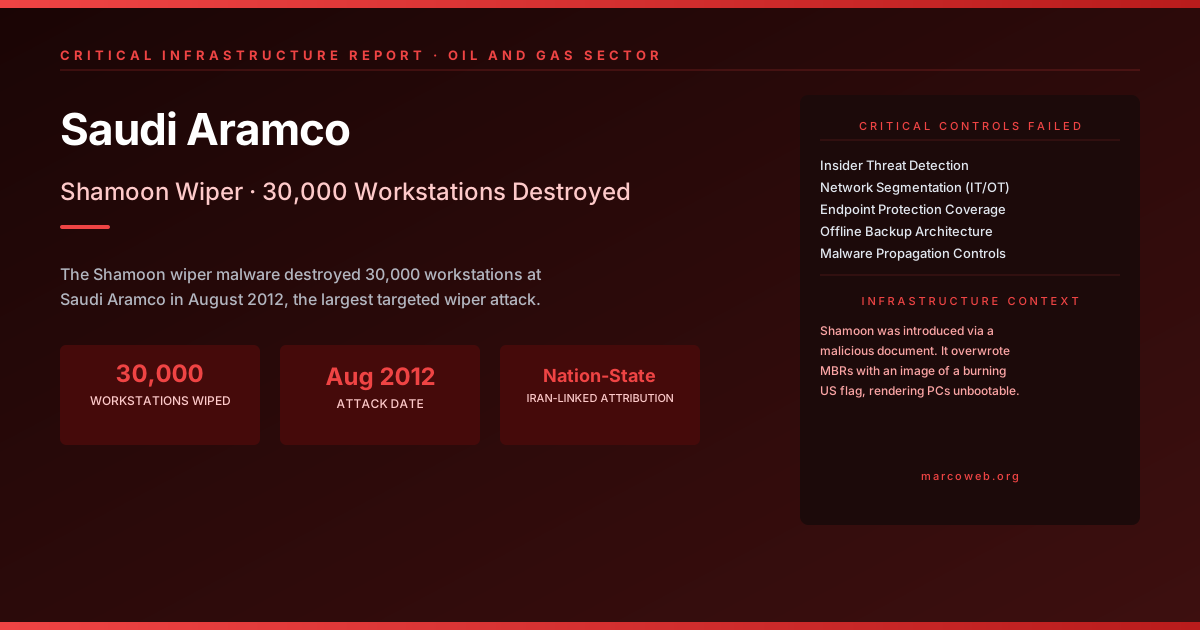
On 15 August 2012, the Shamoon malware (also known as Disttrack) was simultaneously activated on approximately 30,000 Saudi Aramco workstations at 11:08 AM local time, timed to coincide with the beginning of the Islamic holy day of Eid al-Fitr, when only a skeleton IT staff was present. The malware overwrote files on infected systems with an image of a burning American flag, then corrupted the master boot record (MBR), rendering the machines unbootable.
Saudi Aramco, the state-owned oil company of Saudi Arabia and at the time the world’s most valuable company by asset value, was effectively blinded across its office infrastructure for approximately two weeks. Saudi Aramco was forced to disconnect its systems from the internet and operate on paper-based processes. The oil production systems, which ran on separate operational technology (OT) networks, were not affected: Saudi Aramco continued to produce oil throughout the attack. The targeted systems were the administrative and IT infrastructure, not the production control systems.
The attack is assessed to be the largest targeted wiper attack against a single organisation in history at the time of its execution. It established a template that subsequent nation-state actors have followed: use destructive malware to impose maximum disruption on a target without touching the production systems, creating costs and operational disruption while maintaining deniability about intent to cause catastrophic infrastructure failure.
Incident Overview
Date: 15 August 2012 (Shamoon activation); discovery and response over subsequent weeks
Organisation: Saudi Aramco (Saudi Arabian Oil Company)
Systems affected: Approximately 30,000 workstations across Saudi Aramco’s office and administrative infrastructure
Mechanism: Shamoon wiper malware that overwrote file data with an image and then corrupted the MBR, preventing system boot
OT systems affected: None confirmed; oil production continued throughout
Attribution: The US government and cybersecurity researchers attributed the attack to Iran; a group calling itself “Cutting Sword of Justice” claimed responsibility, citing Saudi Aramco’s role in supporting what they described as Saudi government oppression
Recovery: Saudi Aramco replaced approximately 30,000 workstations; recovery to full operations took approximately two weeks
Significance: At the time, the largest targeted destructive malware attack in history; established the wiper attack as a nation-state tool against energy infrastructure
Technical Analysis: Shamoon’s Architecture
Shamoon was not a sophisticated piece of malware from a technical perspective. Its sophistication was operational: the coordination of simultaneous activation across 30,000 workstations on a chosen date and time represents a significant operational planning capability.
Components:
Dropper: The initial infection mechanism, which installed Shamoon on a host and established it on the network. The specific initial access vector has not been definitively confirmed publicly; phishing is the most commonly cited hypothesis.
Spreader: A module that propagated Shamoon to other systems on the network using Windows file-sharing mechanisms and shared administrative credentials. This component is what allowed Shamoon to spread from its initial infection point to 30,000 machines across the Saudi Aramco estate.
Wiper: The destructive payload. The wiper first overwrote files on the infected system with a fragment of a photograph of a burning American flag. It then corrupted the MBR, the portion of the hard drive that contains the code necessary to boot the operating system. Without a valid MBR, the machine cannot boot.
Reporter: A module that reported back to a command-and-control server with information about which systems had been successfully wiped.
The timing: The 11:08 AM activation on 15 August 2012 was deliberate. Eid al-Fitr, the holiday marking the end of Ramadan, meant that most Saudi Aramco staff were away. The skeleton IT staff on duty faced a rapidly spreading destructive malware event with reduced team capacity to respond.
What Shamoon was not: Shamoon did not target Saudi Aramco’s operational technology systems, the industrial control systems that manage the actual extraction, processing, and distribution of oil and gas. This was either a deliberate choice (to cause disruption without triggering a catastrophic production failure that would have justified military response) or a reflection of the technical separation between the IT and OT networks that is a fundamental design principle of Saudi Aramco’s infrastructure.
Why Wipers Are a Nation-State Weapon
The Shamoon attack introduced many organisations and governments to a threat model they had not fully considered: a nation-state adversary that uses destructive malware as a weapon without the profit motive of ransomware.
Ransomware: encrypts data and demands payment to decrypt. The attacker wants the victim to pay; complete destruction is counterproductive. There is a recovery pathway.
Wiper malware: destroys data and renders systems unbootable. There is no payment demanded and no recovery pathway for the wiped data. The goal is maximum disruption.
Why states use wipers: A wiper attack on an adversary’s critical infrastructure or commercial sector can impose significant economic and operational costs while remaining below the threshold of an armed attack under international law. The attacking state can deny responsibility. The victim faces months of recovery work. The strategic calculus is that a wiper attack is a low-cost, deniable means of imposing high costs on a target.
The Shamoon template has been reused. The 2018 Shamoon 2.0 attack again targeted Saudi organisations. The NotPetya attack of 2017 used a similar wiper mechanism wrapped in ransomware aesthetics. The attacks on Ukrainian organisations before and during the 2022 Russian military invasion used wiper malware. The wiper is now a standard tool in the nation-state cyber arsenal.
ITGC Control Failures
Lateral Movement Prevention: Shamoon’s ability to spread from its initial infection point to 30,000 workstations required access to Windows file-sharing services across the estate and access to shared credentials or administrative access. Network segmentation that restricted lateral movement between network zones, and privileged access controls that prevented any single credential from accessing all systems, would have limited the wiper’s propagation from the initial infection point.
Credential Management and Shared Account Controls: The Shamoon spreader component relied on Windows administrative credentials to move laterally. Shared administrative accounts with the same credentials across all workstations are a force multiplier for any spreading malware: one credential provides access to the entire estate. Unique, managed local administrator credentials (implemented through tools such as Windows LAPS) prevent this.
Backup and Recovery for Destructive Scenarios: Saudi Aramco’s recovery from the wiper attack involved replacing approximately 30,000 workstations. The recovery timeline of approximately two weeks reflects the time required to source, deploy, and configure replacement hardware, not the time to restore from backup (because the MBR corruption prevented booting into the OS to restore). Backup and recovery planning for a wiper scenario differs from ransomware recovery: the recovery unit is the physical machine, not just the data. Imaging-based rapid deployment capabilities, where pre-configured system images can be applied to replacement hardware at scale, reduce recovery time.
Incident Response Readiness for Nation-State Destructive Attacks: The Shamoon attack struck on a holiday with reduced staff. A destructive malware scenario, which represents the worst-case incident type from a recovery cost perspective, requires a defined response plan that can be activated rapidly with a reduced team. The response plan should include: network isolation procedures, out-of-band communication channels (since corporate email and instant messaging may be unavailable), hardware replacement logistics, and pre-positioned rebuild capabilities.
Separation of IT and OT Networks: The fact that Saudi Aramco’s operational technology systems were not affected by Shamoon is attributable to their separation from the administrative IT network. This separation is not a given in all industrial organisations; it is a deliberate design choice. Where IT and OT networks share connectivity, a wiper attack that reaches OT systems could cause production failures that extend far beyond administrative disruption.
The energy sector occupies a specific position in the threat landscape for state-sponsored cyber operations:
Energy infrastructure as a geopolitical lever: Oil and gas production represents a direct source of state revenue for producing nations. Disrupting a competitor’s or adversary’s energy infrastructure is a geopolitical act with economic and political consequences.
Energy companies as intelligence targets: The operational data of energy companies, including production capacity, reserve estimates, pricing strategies, and contractual relationships, is intelligence of strategic value to state actors.
OT/IT convergence creates new attack surfaces: The increasing connectivity of operational technology to corporate IT networks, driven by the commercial benefits of data analytics and remote monitoring, creates pathways for cyberattacks to reach production systems. The IT/OT separation that protected Saudi Aramco’s production from Shamoon is being eroded in many organisations.
Supply chain targeting: Energy sector supply chains, including pipeline operators, drilling contractors, and technology vendors, represent alternative entry points to reach energy infrastructure.
Lessons and Recommendations
Implement network segmentation to prevent lateral propagation across workstation estates. A wiper or ransomware that enters through a single workstation should not be able to spread to every other workstation on the network. Segmentation, combined with monitoring for propagation-characteristic network traffic, contains outbreaks.
Deploy unique local administrator credentials using Windows LAPS or equivalent. Shared local administrator credentials across an estate are the mechanism by which lateral-propagating malware reaches every host. Unique credentials managed through LAPS eliminate this spreading pathway.
Maintain and test a rapid workstation rebuild capability. In a destructive malware scenario, recovery means rebuilding the machine estate, not restoring from backup. A pre-defined process for deploying standard system images to replacement hardware at scale significantly reduces recovery time.
Conduct and rehearse a business continuity plan for loss of all IT systems. Saudi Aramco operated on paper during the Shamoon recovery. A business continuity plan that defines how core business functions continue without IT, and that is rehearsed, reduces operational disruption during recovery.
Maintain strict IT and OT network separation. The separation between IT and OT networks prevented Saudi Aramco’s production from being affected. This separation must be treated as a security control and defended against the business pressure to connect OT data to IT analytics platforms without appropriate segmentation.
Assessment Framework for Energy Sector Organisations
The ITGC controls most directly implicated in this incident map to the following audit testing areas:
- Network segmentation: workstation estate, administrative, and OT network separation
- Local administrator credential management and LAPS implementation
- Backup and recovery planning calibrated for destructive malware scenarios
- Business continuity planning for complete IT system failure
- IT/OT network separation controls and approved connection pathways
Open the ITGC Audit Tool