In the digital age, information has become a valuable asset, and its protection is vital for individuals, businesses, and organizations. Information security, encompassing principles such as confidentiality, integrity, and availability, plays a crucial role in safeguarding sensitive data from unauthorized access, manipulation, or loss.
As the world becomes increasingly connected through digital networks, the importance of information security cannot be overstated (Fruhlinger, 2020).
Information security, as defined by the National Institute of Standards and Technology (NIST), involves safeguarding information and information systems from unauthorized access, use, disclosure, disruption, modification, or destruction to ensure three key objectives: confidentiality, integrity, and availability.
“The protection of information and information systems from unauthorized access, use, disclosure, disruption, modification, or destruction to provide confidentiality, integrity, and availability.” (NIST)
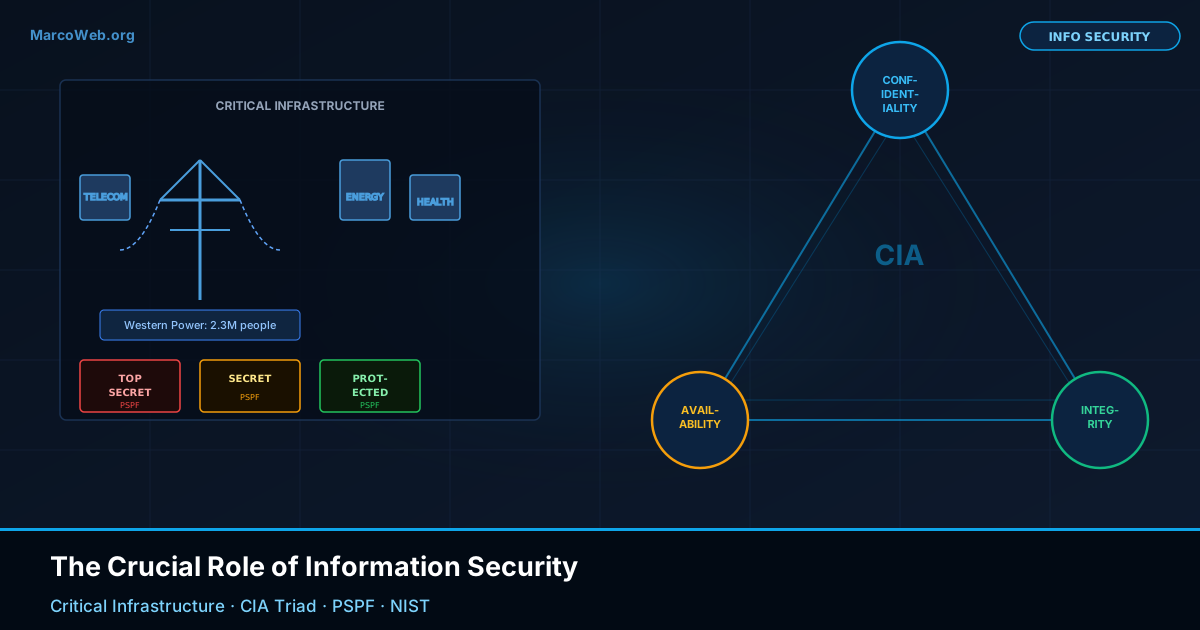
The foundation of data security lies in the CIA Triad:
- Confidentiality: defines what information is confidential and ensures it is accessible only to authorised individuals.
- Integrity: ensures data remains unaltered from its original form and is authentic and accurate.
- Availability: ensures authorised users can access information when needed.
Effective security of data involves the strategic classification of information based on sensitivity and value. In Australia, classification is regulated by the Protective Security Policy Framework (PSPF).
Classifications such as PROTECTED, SECRET, or TOP SECRET are applied when the potential impact of compromising the information reaches high or above levels of consequence (The Attorney-General’s Department, n.d.).
Critical infrastructure refers to the essential systems, assets, and services vital for a country’s economy, national security, and public safety (CISA, 2022). These infrastructures are considered crucial because their disruption or destruction would have a significant impact on the nation.
Western Power, for example, is responsible for providing electricity to 2.3 million individuals in Western Australia. Any operational problems or interruptions have the potential to impact millions of people and essential sectors that rely on reliable energy supply (Western Power, 2022).
The interconnectedness between various critical infrastructure systems makes them susceptible to cascading effects; a single breach in one system can trigger disruptions across multiple sectors (Palleti et al., 2021).
Critical infrastructure entities constantly face threats from cyber-attacks, which could lead to catastrophic consequences (Huang et al., 2023). Key impacts include:
- Economic losses due to downtime, recovery costs, and legal liabilities
- National security threats from adversarial state actors
- Public safety risks when essential services fail
- Cascading failures across interconnected sectors
Breaches of critical infrastructure can result in severe economic losses, threaten lives, compromise national security, and create widespread chaos (Klimburg et al., 2022).
Conclusion
Information security plays a critical role in the digital age. The CIA Triad forms the foundation of information security, aiming to protect sensitive data from unauthorized access, manipulation, or loss.
For critical infrastructure, which includes essential systems and services vital for a nation’s functioning, information security becomes even more crucial. Entities must assess the sensitivity and security classification of their information holdings and establish operational controls proportional to their value and importance.
Information security remains an ongoing process that requires continuous monitoring, improvement, and adaptation to the evolving cyber threat landscape (Noe et al., 2023).
References
- CISA. (2022). Critical Infrastructure Sectors. https://www.cisa.gov/topics/critical-infrastructure-security-and-resilience/critical-infrastructure-sectors
- Fruhlinger, J. (2020). What is information security? Definition, principles, and jobs. CSO Online.
- Huang, K., Wang, X., Wei, W., & Madnick, S. (2023). The Devastating Business Impacts of a Cyber Breach. Harvard Business Review.
- Klimburg, A., et al. (2022). Here’s why securing critical infrastructure is so important. World Economic Forum.
- National Audit Office. (2018). Investigation: WannaCry cyber attack and the NHS.
- NIST. (n.d.). information security - Glossary. https://csrc.nist.gov/glossary/term/information_security
- NIST. (2018). Framework for Improving Critical Infrastructure Cybersecurity, Version 1.1.
- Office of the Auditor General Western Australia. (2023). Security Basics for Protecting Critical Infrastructure from Cyber Threats.
- Palleti, V. R., et al. (2021). Cascading effects of cyber-attacks on interconnected critical infrastructure. Cybersecurity, 4(1).
- Western Power. (2022). Statement of Corporate Intent 2022–23.